Up to the minute information on news, events and day to day happenings at St. Bridget Nurseries and Garden Centres Exeter. For further information on the company visit www.stbridgetnurseries.co.uk
Wednesday, May 02, 2007

Tuesday, May 01, 2007
Common Name: Pasque flower.
Likes a sunny position in well drained soil. This plants grows about 20cm tall and has a spread of 20cm. The pretty spring flowers are followed by fluffy seed-heads. The Royal Horticultural Society has given it their prestigious Award of Garden Merit (AGM) in recogntition of its outstanding excellence. Pulsatilla takes a while to get established and does not like to be disturbed, so plant it in the right spot and leave alone. If happy, plants will self-seed, so leave the seedheads to allow colonies to build up.
Monday, April 30, 2007

Thursday, April 26, 2007
Wednesday, April 25, 2007
New at St Bridget's
Diascias are easy to grow, low maintenance plants which flower for an extensive season beginning in spring.
These diascias are particularly prolific and attractive varieties producing bright mid pink and coral coloured flowers which smother a dense, compact mound of foliage.
Diascias are so called because they have two 'spurs' (in Greek - di - ascia,) at the back of their flowers.
These plants are great for fast results in a new gardens or containers and they make a particularly showy display when planted in drifts of 3-5 plants. Can be grown in containers and hanging baskets.
Should be positioned in full sun in a well drained but moist soil.
A light trim after a main flower flush is all that is required to keep a neat habit as well as encouraging further flower production. For best results apply a slow release plant fertiliser.
Tuesday, April 24, 2007
Hardy hybrid rhododendrons vary in foliage, flowers and forms but mostly have dark evergreen leaves, present all year. The variety ‘Pink Pearl’ is an old favourite as pictured above. Even if you live in an area where the soil is predominantly alkaline, where it is considered difficult to grow rhododendrons, it is sometimes possible to gain some success by treating the soil around the plants four times a year with an Ericaceous Plant Food.
Dwarf evergreen varieties
These are low-growing shrubs that flower in spring. Numerous flower colours and flower forms are available, the small varieties are very effective when planted in rock gardens and are a good choice for patios, where there is some shade.
Large evergreen varieties
These rhododendrons grow tall and are suited to woodland settings. The leaves are dark green or they can be brownish in colour. Two varieties that have won the RHS Award of Garden Merit are ‘Purple Splendour’ flowers are purple with black blotches , and R. ‘Susan’ a delicate lilac shade. All these varieties grow to a height of between ten and twelve feet eventually.
Soil Requirements
To grow well, Rhododendrons require acid compost (one that is not alkaline, chalky or limy). It should also be rich in organic matter and not compact. Peaty compost is suitable or sandy loam.
If you live in a chalky area, Rhododendrons and Azaleas look great in pots, just don't stand them in water filled saucers. Plant in Ericaceous compost. Since many rhododendrons are scented it adds to their appeal as pot plants.
Many rhododendrons grow best with some shade during the day. After the flowers have faded, remove unwanted rhododendron seed heads and mulch the ground around the shrubs, this is usually in the summer, to ensure another fabulous display next year.
Monday, April 23, 2007
Look at these beautiful Morello Cherries, so dainty and great for attracting bees and other wildlife. What's more these trees are an early fruiting variety of cherry producing lovely, dark red cherries, ideal for stewing, in August. A popular, self-fertile cherry that is suitable for north facing situations and can tolerate heavy soil. These cherries are currently growing in the fields at St Bridget Nurseries but you can buy containerised plants from their garden centres or order a bare-rooted specimen directly dug from the field next November.
Friday, April 20, 2007

Thursday, April 19, 2007
- It must be of outstanding excellence for ordinary garden decoration or use
- It must be available
- It must be of good constitution
- It must not require highly specialist growing conditions or care
- It must not be particularly susceptible to any pest or disease
- It must not be subject to an unreasonable degree of reversion in its vegetative or floral characteristics
Wednesday, April 18, 2007
Tuesday, April 17, 2007

The tours are taking place on April 30th, May 1st and 2nd with two tours each day (10.30am and 2.30pm). Visitors will get exclusive access to the working nursery which was named Nursery Retailer of the Year 2006. You will meet the experts from the propagation, greenhouse, herbaceous, container and field grown tree departments. Horticultural techniques and methods will be demonstrated such as micro-propagation, using compost tea as well as making compost and potting a range of crops. At the end of the tour each visitor will get a free goody bag including a voucher to use at both St Bridget Nurseries’ garden centres in Exeter.
A minimum donation of £2.50 is requested for tickets with all the funds going to CHSW. Tammy Flinn, from St Bridget Nurseries, said: “When we have run tours in the past they are always extremely popular. Visitors always comment how huge the nursery is and how they never realised so much is involved in producing the plants they buy from our garden centres. We’ve been growing plants on the nursery in Old Rydon Lane for over 80 years and so this is a great chance to see just how we do it!"
“We hope people will be as generous as possible to support Children’s Hospice South West.”
Tickets are available from St Bridget Nurseries garden centres (Old Rydon Lane and Sidmouth Road, Clyst St Mary, Exeter) or to reserve your place please contact St Bridget Nurseries on 01392 873672
Monday, April 16, 2007
Again, if space is at a premium, how about some tapestry planting. This is the idea of taking a number of plants and letting them grow intertwined. In the case of vertical gardening, its climbers we are concerned with, so how about the idea of seasonal tapestry planting. We could have winter Jasmine, followed in spring by a Clematis, summer time can be taken up by a plant with a long flowering period, an old Rose would be perfect. Finally, in autumn, lets go for some foliage colour.
Wednesday, April 11, 2007
Thursday, April 05, 2007
Wednesday, April 04, 2007

Tuesday, April 03, 2007

Dwarf Rhododendrons have stunning colour and big blooms and will put a real swing into your spring garden.
These plants are huge on impact. For Easter why not choose yellow or white dwarfs in a tasteful pot, dress the display up with ribbons as an ideal Easter Gift - or at St Bridget Nurseries they'll gift wrap it for you. Of course you don’t need to stop at dwarf varieties – there are any number of species and varieties of rhododendrons. Easy to grow, reliable and a stunning floral show each year that is deeply satisfying.
Monday, April 02, 2007

WEDDING FLOWERS!
Friday, March 30, 2007
Thursday, March 29, 2007
Wednesday, March 28, 2007

1 x Chatsworth 155 x 92cm Rectangular Table
6 x Chatsworth Armchairs
6 x Spice mid range seat pads
The usual price for this set is £ 1071.99 but St Bridget's are offering a £270 saving and selling it for £ 799.99!
Tuesday, March 27, 2007

Monday, March 26, 2007
Greenhouses can get very hot very quickly in Spring sunshine and so you may want to think about putting up some shading.
Give pots of amaryllis a high potash fertiliser like Tomorite and start to prick out seddlings that have germinated.
If you brought fuchsias and pelargoniums in over the winter now is a good time to start watering them again to start growth.
Friday, March 16, 2007

Thursday, March 15, 2007
Wednesday, March 14, 2007
Tuesday, March 13, 2007

Thursday, March 01, 2007
Wednesday, February 28, 2007
Simply call your local garden centre, like St Bridget Nurseries in Exeter (01392 873672 or 01392 876281), say what colours you want, they'll give you a bargain price and then once you've ordered they'll do the planting for you. All you have to do is the occasional water and feed!
Tuesday, February 27, 2007
Most of us don't like the rain and are longing for summer but think ahead for your plants who generally love rain!
2006 was officially the UK's warmest year on record and many counties had restrictions on water use. With climate change it is no doubt that we are going to have to be more water wise and the garden is a great place to start. Here are some things YOU can do...
- collect rainfall in water butts while there's plenty of it. Water butts can be purchased at local garden centres.
- Add bulky organic matter like a garden compost, bark or well-rotted manure to soil as this retains mositure in the soil.
- Choose drought-tolerant plants for your borders and containers.
- Use seep irrigation and drip hoses in the summer as they use water more efficiently.
- When things start to heat up water plants ealy in the morning or later in the evening so the moisture seeps into the soil and does not evaporate.
Water butts, irrigation equipment, mulches and drought tolerant plants are all available at St Bridget Nurseries' Garden Centres in Exeter.
Thursday, February 22, 2007
Helleborus Orientalis is the botanical name but it is also known as the Lenten Rose even though they are from the Buttercup family! Hellebores are perennial plants so will come back every year. Their flowers bloom during the Easter celebration of Lent. When they are not in bloom they remain as lush ground cover throughout the year. A must for a small space! At St Bridget Nurseries they have a range of perennials at only £5.25 each plus there are some great bargain ones in 9cm pots for only £1.25 each!
Wednesday, February 21, 2007

Tuesday, February 20, 2007
Monday, February 19, 2007
FRUIT!
Friday, February 16, 2007
- The mild winter we have had means that many more pests will have over wintered and stayed alive but many more predators should survive also. Pay particular attention to pest control in conservatories, glasshouses, cold frames and tunnels as aphid and other pest populations will boom.
- If soil is not too wet, start weeding and digging over borders and any new areas ready for planting.
- Dead head winter pansies to prolong their display.
- Hippeastrums, also known as amaryllis, growing indoors will require watering once or twice a week. Do not over water as the roots may rot. You should see some beautiful flowers very soon.
- Plan a new project for the garden – think about adding something new to your garden, maybe a pond, a new border, planting shrubs that birds will appreciate as well as adding nesting boxes and feeding stations for the birds.
- Cut hedges before birds start nesting.
- How about learning how to propagate? It's easy. Now is the time to take hardwood cuttings of willow and root cuttings of perennials. Pick up all your propagating material along with other gardening bargains at your local garden centre, like St Bridget Nurseries.
Thursday, February 15, 2007
Wednesday, February 14, 2007
Tuesday, February 13, 2007
Thursday, February 08, 2007
Wednesday, February 07, 2007
Tuesday, February 06, 2007
CUT BACK ROSE BUSHESNow is the best time to cut your rose bushes back by a bout a third, pruning out dead and disaesed parts. Pull suckers off (don't cut) close to their point of growth as possible. Not long before you'll have a beautiful summer aray like this gorgeous Lovely Lady Rose from St Bridget's.
Monday, February 05, 2007
Thursday, February 01, 2007
Did you know that St Bridget Nurseries in Exeter was named after the first crop it grew - St Brigid Anemones? And did you know that today is St. Brigid's Day? Saint Brigid of Kildare or St Brigid of IrelandSt (Brigit, Bridget, Bridgit, BrÃd or Bride) (Naomh BhrÃde in Irish; fl. 451- 525) is the secondary patron saint of Ireland, after Saint Patrick. St Brigid was an abbess and the foundress of a number of convents. Her feast day, 1 February, is the traditional first day of spring in Ireland.

MAKE DAPHNE YOUR VALENTINE!
Daphnes aren’t too difficult to please in terms of site and soil requirements, but soils should neither dry out nor become waterlogged. Extremely acidic soils will not be suitable.
Shrubs of this size are perfect for most gardens because they don’t take up too much space. Daphne mezereum has an upright habit of growth and will normally reach no more than 1.2m in height and a spread of 1m and as with the best garden plants, it isn’t just early spring flowers that they deliver. Flowers are followed by attractive fleshy red fruit (inedible), yellow in the case of Daphne mezereum alba. Maintenance is simplicity itself: just trim back any untidy shoots after flowering. Otherwise they will look after themselves very happily.
Wednesday, January 31, 2007
Records suggest that this January could be one of the hottest on record. In Devon we have certainly seen nature behaving like it is Spring - birds are courting and spring flowers are already in flower. St Bridget's Customer Plant Assistant, Debbie, was in the press commenting about these changes yesterday. To read the full story please visit http://www.thisisexeter.co.uk/displayNode.jsp?nodeId=137015&command=displayContent&sourceNode=136999&contentPK=16521316&moduleName=InternalSearch&formname=filtersearch
Tuesday, January 30, 2007

Monday, January 22, 2007
Use fine netting on fruit bushes to protect buds from birds. Similarly safe guard early blossom on plums, peaches and cherries from the frost with protective fleece (available from garden centres like St Bridget Nurseries).
Snip newly planted raspberry canes down to about 23cm-30cm after planting.
Plant rhubarb crowns in February in well-cultivated soil.
Friday, January 19, 2007
Wednesday, January 17, 2007
Tuesday, January 09, 2007
Friday, January 05, 2007
Thursday, January 04, 2007

Looking good!
Wednesday, January 03, 2007
Friday, December 22, 2006

WINTER SHRUBS
Thursday, December 21, 2006

Camellias
With their glossy, evergreen foliage and large flowers in spring (though I've seen many in flower already in Devon) camellias are the perfect way of brightening up the garden. Buy yourself some now or give them as presents.
They need a lime-free soil, so if yours isn’t suitable grow them in large pots in Ericaceous compost.

The presentation, attention to detail and devotion to plants displayed by St Bridget Nurseries in Exeter were key reasons why the judges selected it to be this year’s Nursery retailer of the year. St Bridget’s combines over 80 years of plant growing history and heritage with modern marketing practices and retail skills. The nursery is separated into six departments—propagation, micro-propagation, container grow nursery stock, herbaceous, greenhouse and open ground nursery stock. Production largely supplies the two garden centres situated on the outskirts of Exeter, though it also fulfils trade, mail and e-mail orders. A great focus has been put on marketing initiative in the past year, with advertising via local radio and print media. The garden centres have recently been approved by The Devon Wildlife Trust, allowing them to promote products that are wildlife friendly by placing the DWT logo on plant bed labels. In a bid to reduce the need for chemicals in production, biological control has been used wherever possible. For the last two years Compost Tea has been used which has both enhanced growth and reduced the need for fungicide applications. The company has also hosted events, with speakers covering topics such as garden design, wildlife gardening and planning for the future.
Says Tammy: “This award is a fantastic achievement and a great recognition of the hard work and enthusiasm of everyone who works here. I’d personally like to dedicate the award to my late grandfather, Norman Langdon, who led the company for 63 years with inspiring promotion of horticulture. He would be really proud of us.”

Potted trees should be watered regularly so the compost doesn’t dry out. Cut trees can be stood in self-watering stands and the reservoir topped up daily. To help improve water uptake, remove the bottom inch or so of stem from cut trees before bringing them indoors. And you can help even further by spraying all live Christmas trees with an anti-desiccant – such as Spray ‘N’ Save – before moving them indoors.
Friday, December 01, 2006

Poinsettias
When you get them home give them a position in plenty of good light and an average temperature of 55-60F – but keep them away from radiators and other sources of heat – and out of draughts and fluctuating temperatures.
Allow the top of the compost to dry slightly before watering, but then give them a thorough watering ensuring all the compost is moist and feed with a houseplant fertiliser each time. Daily misting of the leaves will help ensure good colour and healthy growth.
Good luck and remember to pick up your St Bridget Nurseries guide to growing Poinsettias before you leave their garden centre.
Thursday, November 16, 2006

Create your own fruit garden – now’s an excellent time to plant fruit trees and bushes, and St Bridget Nurseries have lots to choose from.
To ensure bumper crops, plant with plenty of organic matter and slow-release fertiliser and make sure you train bushes where necessary and use stakes and ties for fruit trees. It's easy to grow your own and think if the environmental benefits...save on food miles and knowledge that what you are eating is fresh and chemical free!
Make gooseberry fool with Gooseberries, Redcurrant jelly or Cranberry sauce for next year's Christmas meal. Blackberry and apple crumble, summer pudding or simply an Apricot! There's lots to choose from so give it a go and grow your own!
We've also been given a special BLOG offer! Spend over £10 on fruit plants and trees in one single transaction between now and December 11th and present a copy of this blog and you will receive a FREE recipe book - Favourite Apple Recipes - which has over 30 fruit recipes in it!
Thursday, November 09, 2006
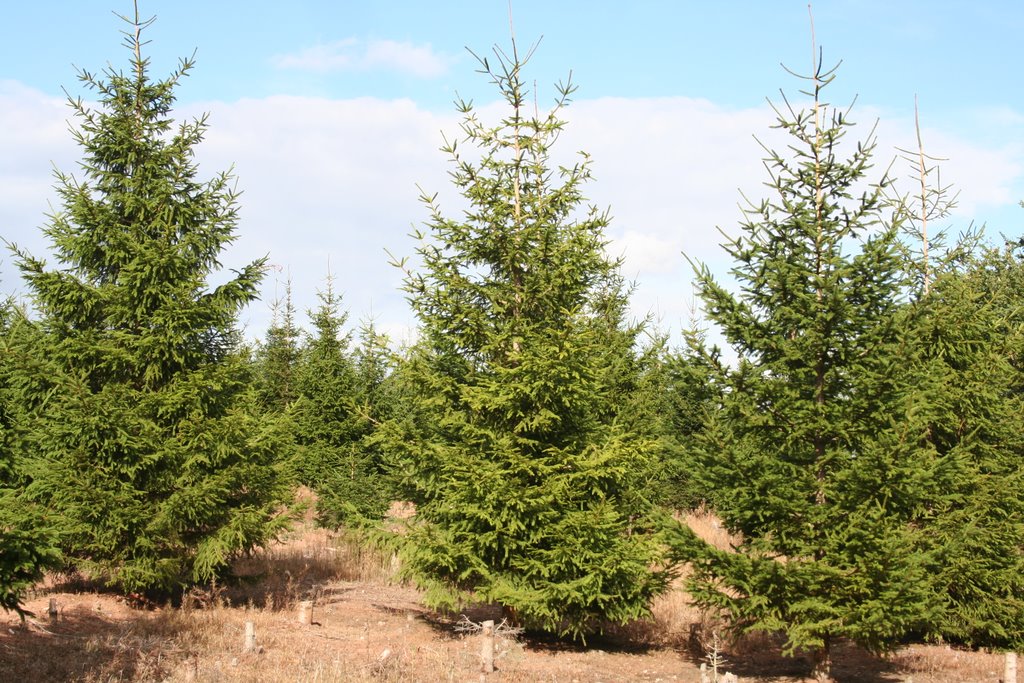
Planting evergreens is one of the best ways of bringing colour and texture to the garden at this time of year. It’s hard to beat the value of conifers for the winter garden. There are so many colours and shapes – and because there are types that grow from a few inches to several feet high, there are types for every garden and situation.
If you choose carefully you can also get evergreen plants with some welcome winter flowers. Try planting mahonia, Viburnum tinus and winter-flowering heathers. And don’t forget that some evergreens also produce colourful berries at this time of year – such as pyracantha, skimmia and cotoneaster.
If you have a look around St Bridget's planteria you’ll see there are plenty of ideas for turning your garden into a winter wonderland.
And, as with all plants, get them off to a flying start by planting with compost and a slow-release fertiliser.
Wednesday, November 01, 2006
Now’s a good time to plant a hedge and here’s how to ensure you get the best from your new hedges.
Hedges are the perfect solution for providing a colourful, natural-looking boundary to a garden. And there are lots of plants suitable for providing a hedge, barrier or screen – whether you want evergreen or deciduous, formal or informal.
It’s important that you prepare the soil well. Start by digging out a trench at least 18 inches wide and 12 inches deep. Fork over the base of the trench and incorporate plenty of organic matter – such as well-rotted manure, compost, composted bark or planting compost. Mix the excavated soil with lots more organic matter and some bonemeal or controlled-release fertiliser, and re-fill the trench – firming the soil as you go.
Before planting water the plants well; you should place the roots of bare-root plants in a bucket of water for half an hour. Then plant at the right distance; most types should be planted 18 inches apart, although conifers and more vigorous types can be planted two to three feet apart. After planting water in well, and water during dry spells for the first year. St Bridget Nurseries have lots of suitable hedging plants including cheaper bare-rooted plants – pop in to get that privacy from the neighbour that you’ve always wanted ;-)
Friday, October 27, 2006
Wednesday, October 25, 2006
Tuesday, October 24, 2006

Birds of a feather...
Wednesday, October 11, 2006

Get ready for Halloween...
Tuesday, October 10, 2006

Going bare?
Monday, October 09, 2006
Thursday, October 05, 2006
Although most pests in the garden are less active in the autumn, it pays to keep an eye out for any problems and deal with them as soon as possible.
Many pests will lay eggs on plants for overwintering and these will attack early next year. Deciduous trees and shrubs that have dropped their leaves can be treated with Growing Success Winter Tree Wash.
Slugs and snails will be very active during damp weather, so protect vulnerable plants with your favourite control method - remember there are wildlife friendly options such as copper tape.
Wednesday, October 04, 2006
Monday, October 02, 2006

CONIFERS ARE IN!
Wednesday, September 06, 2006

Don't have a car?
Tuesday, September 05, 2006
Staff at St Bridget Nurseries Clyst St Mary garden centre are celebrating an award of merit!
Each year all garden centres who are members of The Garden Centre Association are inspected. Repeatedly St Bridget's staff are recognised for their high standards in customer service and they are pleased to accept this prestigious award which reflects ones of the highest marks in the country.
Friday, September 01, 2006
SEDUMS - PLANT OF THE MONTH!The Sedum family, also known as stonecrops or ice plants, are fleshy succulent plants. Sedum spectabile ‘Brilliant’, available from St Bridget Nurseries in Exeter, is a clump-forming perennial variety that is a wonderful choice for any garden. The large, flat flower heads grow in profusion and are covered in star-shaped rose pink flowers that bloom in late summer and last well into the autumn. Sedums are also one of the many plants to be included in the St Bridget Nurseries Wildlife Garden Range as approved by the Devon Wildlife Trust. Sedums are worth including in any wildlife garden, as they are an important late summer food plant for bees and butterflies, who feed on the flower nectar and once the flowers fade, birds feast on the seeds. Sedum spectabile ‘Brilliant’ is available with a wide range of other Sedums from St Bridget Nurseries for just £5.75 a plant.
Thursday, August 31, 2006

ROSE SALE!!
Wow - beautiful roses are now 1/3rd off at St Bridget Nurseries in Exeter. They are still in flower and looking great and at such good prices it would be cruel to my garden to miss out! I'd better hurry though as this offer is only on stock already in their garden centres and only while stocks last!